



A parking lot can look adequately lit from a distance and still leave the areas that matter most in shadow: the walk from a vehicle to the entrance, the cart return, the dumpster enclosure, the side of the building, or the spaces between light poles. The best parking lot safety lights do more than make pavement brighter. They help customers, employees, tenants, and visitors see where they are going, recognize potential hazards, and feel more comfortable using your property after dark.
For business owners and property managers, the right answer is rarely a matter of buying the brightest fixture available. A safer result comes from a lighting plan that considers fixture placement, beam distribution, glare, controls, electrical capacity, maintenance access, and local requirements. That is especially true for busy retail centers, restaurants, medical offices, apartment communities, and industrial properties throughout Louisville and Southern Indiana.
What Makes Parking Lot Lighting Safer?
Safe parking lot lighting is about useful visibility, not raw wattage. People need to distinguish curbs, wheel stops, striped lanes, changes in elevation, pedestrians, and moving vehicles. Security cameras also need consistent light to capture usable images. When one part of the lot is extremely bright and the next is very dark, the eye has to keep adjusting. That contrast can make hazards harder to see.
Uniformity is one of the most important measures of a successful installation. A good layout reduces dark pockets without creating excessive brightness directly beneath each pole. It should also provide a clear visual connection from parking spaces to sidewalks, building entrances, and accessible routes.
Glare deserves equal attention. A poorly aimed floodlight or a fixture with the wrong optic can shine into drivers’ eyes, neighboring properties, or upper-floor windows. More light is not automatically safer light. Proper shielding and distribution put illumination on the pavement and pedestrian paths where it does the most good.
Best Parking Lot Safety Lights by Area
The best fixture depends on the job it needs to do. Most commercial properties use a combination of lighting types rather than relying on one fixture across the entire site.
Pole-mounted LED area lights
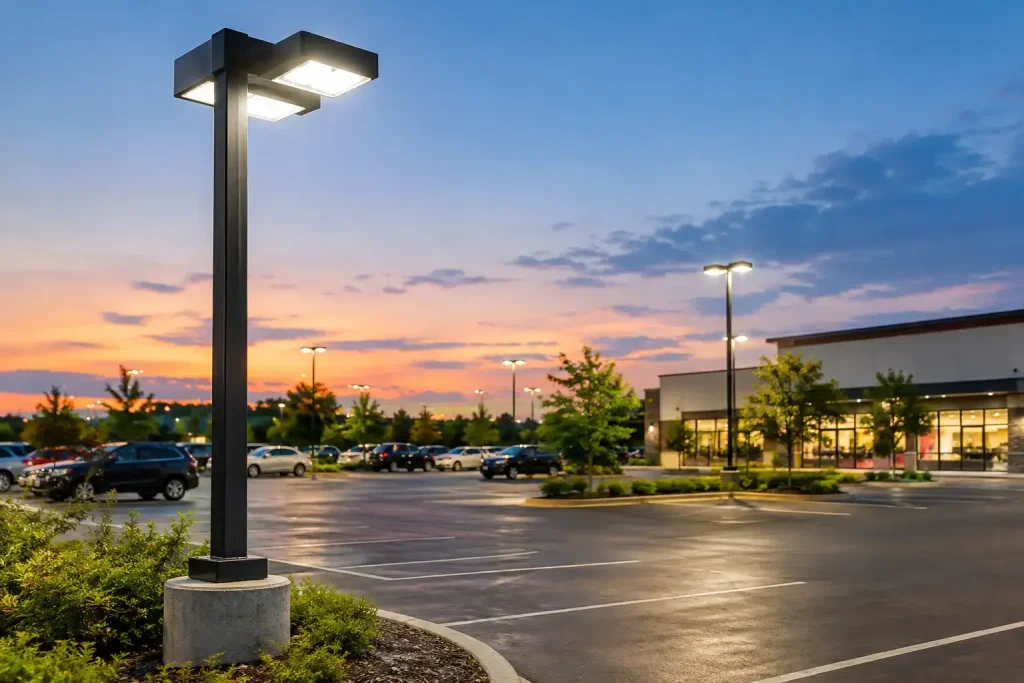
Pole-mounted LED area lights are the workhorse for open parking fields, drive lanes, and larger commercial sites. Mounted at the proper height and spaced according to a photometric plan, they provide broad, even coverage with far less energy use and maintenance than older technologies.
The key decision is the light distribution pattern. A fixture near the center of a lot needs a different distribution than one installed along a property edge. Selecting the wrong optic can waste light beyond the lot while leaving interior parking spaces underlit. Pole height also matters. Taller poles can cover more ground, but they may not be appropriate for a smaller site, nearby residences, or local lighting restrictions.
Wall-mounted fixtures for building edges
Wall-mounted fixtures are effective along storefronts, rear entrances, loading areas, service corridors, and the sides of buildings. They help eliminate the shadow line that can form where pole lighting stops short of the structure.
These fixtures should be positioned to illuminate doors, sidewalks, ramps, and operational areas without throwing light into neighboring windows. For a restaurant, office building, or multi-tenant retail center, wall lighting also helps visitors identify the safest path between their vehicle and the right entrance.
Canopy lights for covered areas
Canopy lights are designed for areas under roofs, including fuel canopies, drive-through lanes, porte cocheres, covered pickup zones, and loading overhangs. Covered spaces can appear dark even when the surrounding lot is well lit, so they need dedicated fixtures that limit shadows around columns and equipment.
For hospitality and medical properties, canopy lighting can make a major difference for guests arriving after dark. The fixture layout should account for ceiling height, column placement, traffic direction, and any signs or architectural features that could block light.
Bollards and pedestrian-scale lights
Bollards and pedestrian-scale lights are useful for sidewalks, landscaped walkways, plaza areas, and transitions between parking and entrances. They are not a replacement for pole lighting in an open lot, but they can make pedestrian routes easier to follow and improve the sense of safety close to the ground.
Durability is a practical concern. Fixtures near vehicle traffic need protection from impact, and low-mounted products need housings that stand up to weather, landscaping work, and routine cleaning. The most attractive fixture is not the best choice if it will be repeatedly damaged by carts, snow equipment, or vehicles.
Brightness, Color, and Coverage Need to Work Together
Lighting specifications can get technical quickly, but property owners do not need to become lighting engineers to ask the right questions. Lumens describe how much light a fixture produces, while foot-candles measure the light reaching a surface. A photometric plan uses those details to show expected light levels across the property before installation begins.
For many commercial parking lots, LED fixtures in the 3000K to 4000K color-temperature range offer a practical balance. A warmer 3000K appearance may suit hospitality, residential, or architecturally sensitive settings. A cooler 4000K appearance often provides a crisp, businesslike look for retail, office, and service areas. The right choice depends on the property, surrounding environment, and the desired nighttime appearance.
Higher color rendering can also help people distinguish colors and details more accurately, which may benefit pedestrian areas, entrances, and camera coverage. Still, color temperature and color rendering should not be chosen in isolation. Even a quality fixture will perform poorly if it is mounted in the wrong location or aimed incorrectly.
Do Not Treat Dark Corners as a Maintenance Issue Only
A section of lot that has gone dark may be caused by a failed fixture, but it can also point to a larger system problem. Corroded wiring, water intrusion, damaged poles, failing drivers, photocell issues, timer errors, voltage problems, or outdated controls can all affect performance. Replacing one fixture without diagnosing the cause can lead to another service call soon afterward.
This is where working with an experienced electrical and lighting contractor helps. A proper evaluation looks at the fixtures, poles, circuits, controls, and condition of the existing electrical infrastructure. It also identifies whether a targeted repair is appropriate or whether a phased LED retrofit will provide a more dependable long-term result.
Rudnick Enterprises helps commercial property owners coordinate lighting work with the electrical repairs, permitting, and site needs that can complicate an otherwise simple-looking project. That single point of responsibility can be especially helpful when lighting upgrades occur alongside signage, remodeling, tenant improvements, or exterior maintenance.
Use Controls That Support Safety Without Wasting Energy
Parking lot lights need dependable operation, not constant manual attention. Photocells, time clocks, astronomical timers, occupancy sensors, and networked controls can all play a role. The best option depends on how the property operates.
For example, a retail center may need full lighting from dusk through closing, followed by reduced but still safe lighting overnight. An office property may benefit from scheduled operation with increased illumination around employee arrival and departure times. Motion-based controls can make sense in lower-traffic service areas, but abrupt changes in light level can be uncomfortable or unsafe if the settings are too aggressive.
Controls should also be accessible for testing and adjustment. A system that is difficult to program or maintain often ends up running at the wrong time, staying on during daylight, or leaving areas dark when they are still in use.
Plan for Code, Neighbors, and Future Service
A lighting project should account for applicable electrical codes, local permitting requirements, and site-specific restrictions. Some locations may have requirements related to light trespass, fixture shielding, pole placement, or maximum illumination near residential property lines. Accessible routes and building entrances also deserve careful attention during planning.
Before selecting fixtures, consider who will service them five years from now. High-mounted lights may require lift access. Fixtures with hard-to-source parts can turn a small repair into a prolonged outage. Choosing commercial-grade products with dependable drivers, available components, and a realistic warranty can reduce future disruption.
A lighting layout should also leave room for property changes. New tenant signage, expanded patio seating, added drive-through equipment, landscaping growth, or a reconfigured entrance can all change how light performs. Planning with those possibilities in mind helps protect the investment.
Start With a Nighttime Walkthrough
The most useful first step is often simple: walk the property after dark. Bring the perspective of a first-time visitor. Can you see the address, entrance, sidewalks, curb edges, and wayfinding signs? Are employees walking through a dark area to reach their cars? Do cameras cover the areas where incidents are most likely to occur?
Document what you find, then have a qualified lighting professional assess the site and develop a solution around actual conditions. A well-planned lighting upgrade is not just an exterior improvement. It is a practical way to make every arrival, departure, and walk across your property feel more secure and better cared for.