



A customer can decide whether to pull into your parking lot long before they reach your front door. That is why knowing how to choose facade signage is about more than picking colors and adding a logo. The right sign makes your business easy to find, supports the impression you want to make, and works safely with your building, electrical service, and local sign requirements.
For a retail storefront, restaurant, office, medical practice, or multi-tenant property, facade signage needs to perform in real conditions: daylight, rain, evening traffic, changing tenants, and competing visual noise. A good sign program starts with practical questions, then turns those answers into a design that is visible, durable, and properly installed.
Start With What the Sign Must Accomplish
Before comparing sign styles, define the job the sign needs to do. A business on a busy commercial corridor may need high visibility from passing vehicles. A shop in a pedestrian district may need a sign that can be read comfortably from the sidewalk. A professional office might prioritize a clean, established appearance over a large illuminated display.
Think about who needs to see the sign, how far away they will be, and how much time they have to read it. Drivers moving at 40 miles per hour need larger, simpler copy than pedestrians standing outside your entrance. If your business is set back from the road, building-mounted signage may need support from a monument sign or directional signs on the property.
Your sign should also fit your business goal. Are you introducing a new location, helping customers locate an entrance, improving nighttime visibility, or making a dated property more lease-ready? Those objectives affect the size, lighting, placement, and budget of the project.
How to Choose Facade Signage for Your Building
A sign can look great in a design proof and still be the wrong fit for the building. Facade signage should work with the architecture rather than cover up important features or feel undersized against a large wall.
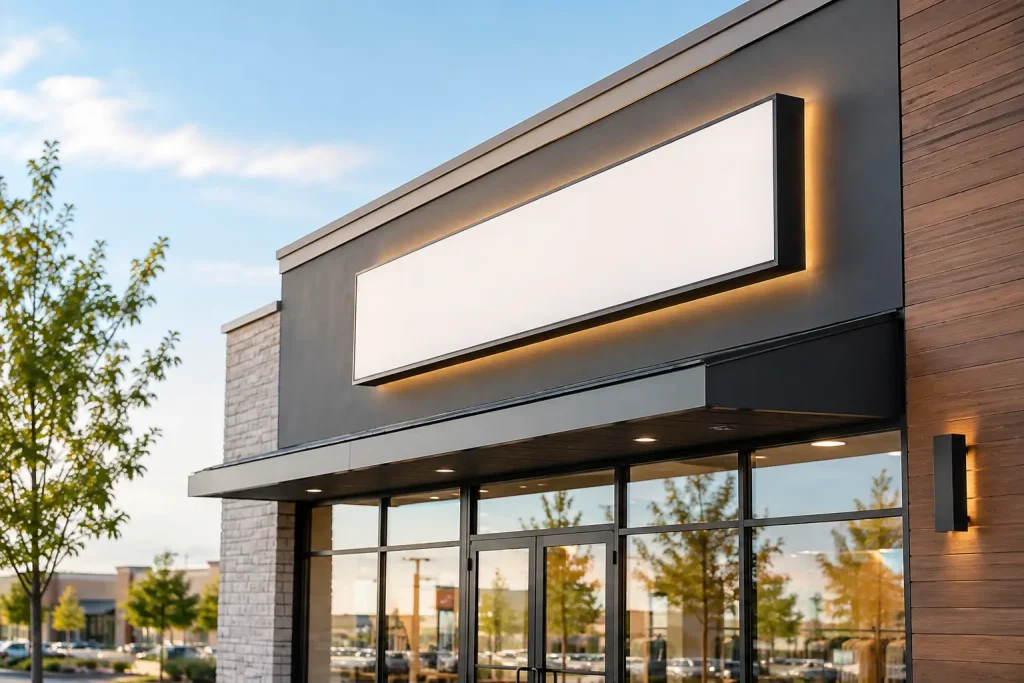
Begin with the available sign band, which is the portion of the facade intended or suited for signage. Measure the usable width and height, but also account for windows, awnings, masonry joints, rooflines, canopies, doors, and mechanical equipment. On multi-tenant buildings, the property’s sign criteria may establish exact locations, dimensions, materials, and illumination rules.
The wall construction matters just as much as the visual layout. Brick, concrete block, stucco, metal panels, EIFS, and wood framing each require different mounting methods. Larger signs may need structural review or engineered attachment details to handle wind loads safely. This is not an area to guess. A poorly planned installation can leave water entry points, damaged finishes, or a sign that does not have the support it needs.
For many storefronts, dimensional letters or a cabinet sign provide a strong balance of visibility and professional appearance. Channel letters can give a brand individual presence, while panel signs may be a practical choice where the message needs to change or where a property has standardized tenant sign areas. The best option depends on the building, viewing distance, local rules, and the image your business wants to project.
Keep the Message Readable
The strongest facade signs are often the simplest. Your business name, primary logo, and perhaps a short descriptor are usually enough. Trying to include services, phone numbers, web addresses, taglines, and several logos can make a sign harder to read from the road.
Choose letter height based on actual viewing distance, not just on what fits in the available space. High-contrast colors help, but contrast is not only about black and white. It is about making letters stand apart from the sign background and the building behind it. Thin typefaces, crowded lettering, and low-contrast color combinations may look refined up close but disappear at a distance.
If your logo includes fine details, ask how it will translate at the final sign size. A simplified version may be more effective on a facade than a detailed version intended for print. This is especially true for businesses that receive a large share of customers after dark.
Decide Whether Illumination Is Worth It
Illuminated facade signage can improve visibility well beyond business hours and help a location remain recognizable in bad weather or during winter evenings. For restaurants, retailers, medical offices, hotels, and businesses with early or late operating hours, lighting is often a practical investment rather than an optional upgrade.
Still, illumination is not automatically the right answer. Some historic districts, office settings, or landlord agreements limit lighting types and brightness. A business that operates only during daylight may place more value on premium materials or a larger non-illuminated sign instead.
When lighting is part of the plan, consider how the sign will be powered and serviced. Existing electrical capacity may be sufficient, or the project may require a new circuit, disconnect, or other electrical work. Accessible components and quality materials make future maintenance simpler. A sign should be designed for years of operation, not just opening day.
Check Permits, Codes, and Property Requirements Early
Sign regulations can control much more than the sign’s size. Depending on the city, zoning district, and property, rules may address sign area, height, location, illumination, projection from the wall, electronic messaging, and the number of signs allowed. Landlord criteria and neighborhood standards can add another layer of review.
Waiting until fabrication is underway to investigate those requirements can lead to redesigns, delays, and unnecessary expense. It is better to confirm what is allowed while the design is still flexible. For a new business, signage timing should also be coordinated with the build-out schedule, certificate of occupancy process, and exterior improvements.
Permitting becomes even more important when a sign needs electrical service or structural engineering. A full-service contractor can coordinate design, engineering, permit documentation, fabrication, installation, and electrical work in one process. That reduces the risk of gaps between the company designing the sign and the team responsible for making it safe and code-compliant.
Budget for the Full Project, Not Just the Sign Face
A facade sign quote can include several different scopes of work: design, surveys, engineering, permit fees, fabrication, installation equipment, electrical connections, and removal of an existing sign. Comparing prices without confirming those details can be misleading.
The least expensive option is not always the best value. Lower-cost materials may fade, crack, corrode, or require more frequent service. Likewise, a sign with limited visibility may save money upfront but fail to bring customers to the door. The goal is to select a solution that fits your budget while delivering the visibility and durability your location needs.
Ask what happens after installation, too. Can individual components be repaired? Is the sign face replaceable if your branding changes? Will the mounting method leave visible damage if the sign is removed later? These questions are particularly useful for property managers and tenants working within lease terms.
Plan for Installation and Long-Term Care
Installation day should not be the first time anyone considers access, traffic flow, wall conditions, or electrical shutoffs. A qualified team will evaluate lift access, parking areas, overhead utilities, public safety, and the condition of the installation surface before work begins.
After the sign is installed, occasional inspection helps protect the investment. Loose fasteners, damaged faces, water intrusion, dim lighting, and storm damage are easier to address when caught early. For multi-tenant properties, consistent maintenance also helps the entire center look professionally managed.
Rudnick Enterprises helps businesses throughout Louisville and Southern Indiana manage these details from early planning through installation and service. That means customers can work with one experienced team when a project involves signage, permitting, electrical infrastructure, and exterior improvements.
A facade sign should give people confidence that they have found the right place. Choose one that is clear from the street, appropriate for the building, approved before production, and built to keep representing your business well long after the grand opening.